
The journal · Desk research
GMT: which hand do you actually need to move?
The fourth hand gets the photograph. The crown positions decide whether you bought the function you wanted.
Start with a Tuesday, not an airport advert
Picture the adjustment you would make most often. Perhaps you stay at home and want to know whether a colleague overseas has finished work. Perhaps you cross time zones and want the ordinary hour hand to show local time when you land. Both are reasonable GMT jobs. They are not the same adjustment.
The usual caller and traveler labels describe a useful distinction, but the calibre instructions are the better evidence. Read what moves independently. If a listing only promises multiple time zones, it has not yet answered that question.
NH34: move the extra hand
TMI’s NH34 technical guide documents separate adjustment of the 24-hour hand. This is the arrangement commonly called caller-style GMT. You can keep the main display on your local time and set the additional hand for another zone.
That makes sense for someone whose location stays fixed while their attention moves elsewhere. You can travel with it, of course. What it does not offer is an independently jumping local-hour hand. If that is the operation you expected, a fourth hand on the dial is not enough to deliver it.
9075: change the local hour
Miyota’s 9075 instructions document a separate local-hour adjustment. This is the useful idea behind traveler-style GMT: changing the hour shown locally without treating the extra hand as the control you need to move.
Consider that arrangement if changing local time is the task you repeat. It does not make every watch containing a 9075 the right watch for you. Dimensions, controls, price and support still belong in the decision. This article compares adjustment types; it does not add a purchase recommendation for a model we have not sufficiently checked.
Same movement, different things to tolerate
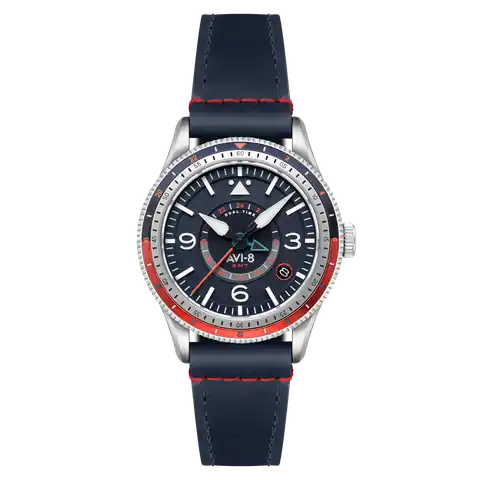
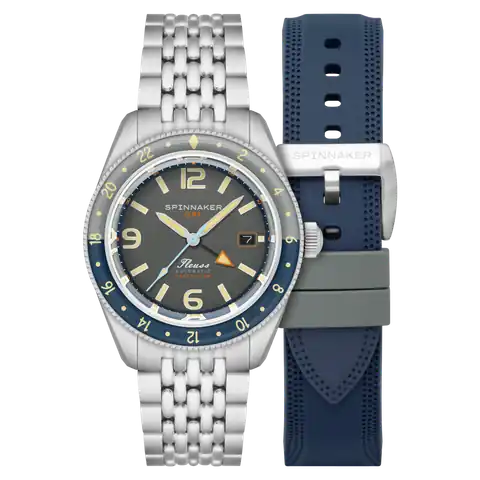
The AVI-8 Airmaster Cockpit Blue and Spinnaker Fleuss GMT Deep Grey both use the NH34. Changing between them therefore changes the case and supplied straps, not this caller-versus-traveler distinction.
AVI-8 publishes a 40mm diameter, 48mm lug span and 15mm thickness. Spinnaker gives the Fleuss 43mm, 51mm and 13mm respectively. The narrower watch is thicker. That is a much more revealing comparison than declaring one compact because its diameter starts with 40.
The AVI-8 is supplied on leather; the Fleuss has a steel bracelet and an additional rubber strap. We have not handled either. Choose the package you want to investigate, then check it against a watch you know rather than converting a specification into a comfort promise.
Make the seller demonstrate the useful bit
Ask for the instructions for the exact calibre, or a clear demonstration of which hand moves independently. That request is more precise than asking whether the watch has a “true GMT”. It also gives you a chance to decide whether the controls fit your routine.
Use the maker’s instructions for actual setting, including its calendar precautions. Our buying guide currently compares two NH34 candidates. If you want independent local-hour adjustment, keep looking for that function; do not let the available shortlist talk you out of the requirement you started with.
Explore the watches
Read the brand research
AVI-8 Timepieces · Spinnaker Watches